A quantitative view of gut glial signalling.
My enteric-glia programme investigates how neurotransmitter inputs, receptor currents, intracellular calcium stores and cellular geometry combine to produce coordinated calcium activity.
The collaboration with Professor Brian D. Gulbransen at the University of Nevada, Reno connects my mathematical and computational work with experimental enteric-glia expertise. The programme builds on our published gHH receptor framework and my earlier microglial modelling.
From receptor dynamics to soma–process signalling.
The planned modelling strategy begins with receptor-driven calcium handling and ionic homeostasis. A subsequent spatial extension will investigate how receptor distribution, process geometry and intracellular transport affect local and whole-cell signalling.
Begin with purinergic pathways and intracellular calcium handling.
Investigate how morphology and transport shape local signals.
Explore consequences of changes in receptor activity and distribution.
These stages describe the research direction, not a claim that the complete spatial model is already available.
Grounded in experimental collaboration.
The programme is designed around calcium imaging, receptor-localisation information and pharmacological perturbations. Calcium activity is the principal experimental constraint; inferred receptor currents, ionic fluxes and membrane-potential changes require their own careful interpretation.
The experimental plans include mouse enteric-glia preparations. The work is motivated by gut physiology and disease research, but is not presented as a fully human-derived experimental dataset or a clinically validated model.
A shared receptor-modelling foundation.
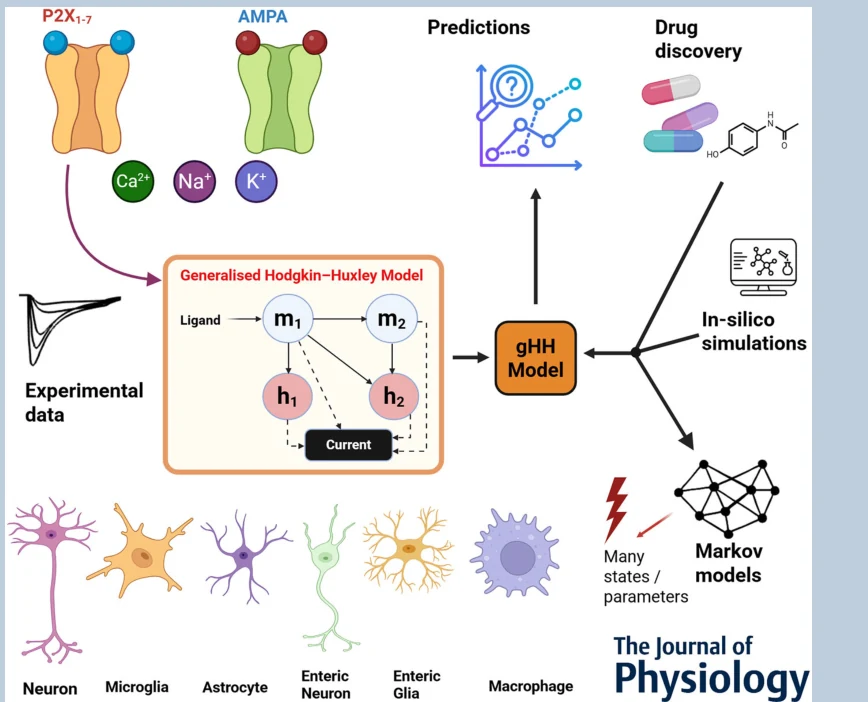
Generalised Hodgkin–Huxley model captures human P2X and AMPA receptor currents
The Journal of Physiology 604(1), 214–246
A shared, interacting-gate framework for human P2X1–7 and AMPA GluA1 receptor currents. First and corresponding author; mathematical framework, fitting and implementation.
Longer-term value.
The aim is to support mechanistic interpretation of glial calcium signals, guide experimental questions and develop reusable models for computational neurogastroenterology. Applications to disease mechanisms and pharmacological research are longer-term possibilities.