A sustained biological programme.
My human-microglia research began during my PhD and continues through collaboration with Professor Mark L. Dallas at the University of Reading. It connects ion channels and purinergic receptors to the membrane and intracellular dynamics of a neuroimmune cell.
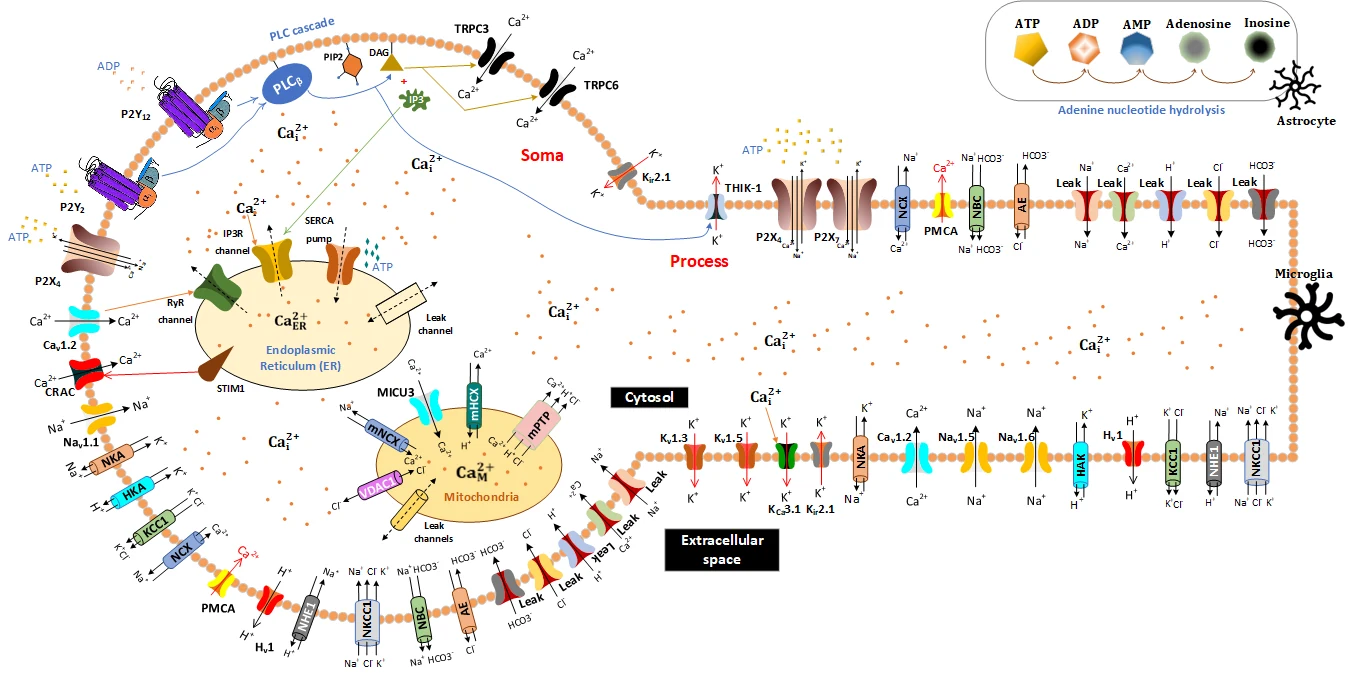
The published work addresses human P2X-mediated electrophysiology and calcium regulation, followed by modelling of the PI3K/Akt pathway. Together these provide a foundation for investigating how receptor inputs, homeostatic transport and intracellular signalling interact.
What the models connect.
ATP/ADP-sensitive receptors and receptor-mediated currents.
Membrane potential, calcium handling, pumps and exchangers.
Calcium-dependent mechanisms and PI3K/Akt activation.
Experimental and computational work together.
I lead the mathematical and computational development, working with experimental expertise at Reading and computational-neuroscience expertise at Hertfordshire. The ongoing direction is to connect model development more closely to electrophysiology and calcium imaging, and to use the models to generate experimentally testable questions.
Spatial modelling of ionic dynamics across cellular compartments is part of the programme’s longer-term development. Current models and published results should be distinguished from these proposed extensions.
The connection to GTG
GTG provides a systematic channel-level theory and computational workflow. The microglia programme remains a distinct cellular research programme, supplying biological questions and a route towards integrated physiological models.
Published contributions.
Mathematical modelling of human P2X-mediated plasma membrane electrophysiology and calcium dynamics in microglia
PLOS Computational Biology 17(11), e1009520
A model integrating human P2X receptor currents, membrane electrophysiology and intracellular calcium. Led methodology, software, data curation and original-draft writing.
Mathematical Modeling of PI3K/Akt Pathway in Microglia
Neural Computation 36(4), 645–676
Mathematical modelling connecting purinergic signalling, calcium regulation and the PI3K/Akt pathway in microglia. First-author research extending the cellular modelling programme.
Doctoral foundation.
Computational Modelling of Plasma Membrane Electrophysiology and Calcium Dynamics in Microglia, Ulster University, 2023.