A common mathematical construction.
GTG investigates how diverse human ion-channel currents can be represented through interacting, bounded gating variables and reusable modules. It builds on my published generalised Hodgkin–Huxley (gHH) framework for human ligand-gated receptors and extends the programme towards voltage-gated channel dynamics.
The scientific object comes first: a model is assembled from gates, modules and explicitly defined modulatory interactions. The language and compiler provide its computational realisation, rather than substituting software for the underlying theory.
A basic module pairs an activation gate with an availability/inactivation gate. Interactions modulate kinetic routes; they should not be read as literal molecular transitions. Larger models are constructed using the same composition rules.
From model specification to experimental comparison.
A GTG specification connects the chosen architecture, current readout, kinetic parameters and experimental protocols. The compiler and fitting workflow make these choices explicit and support iterative model development.
Express the model and its interactions in a structured specification.
Translate the model into an executable computational workflow.
Compare model currents with data and examine the component dynamics.
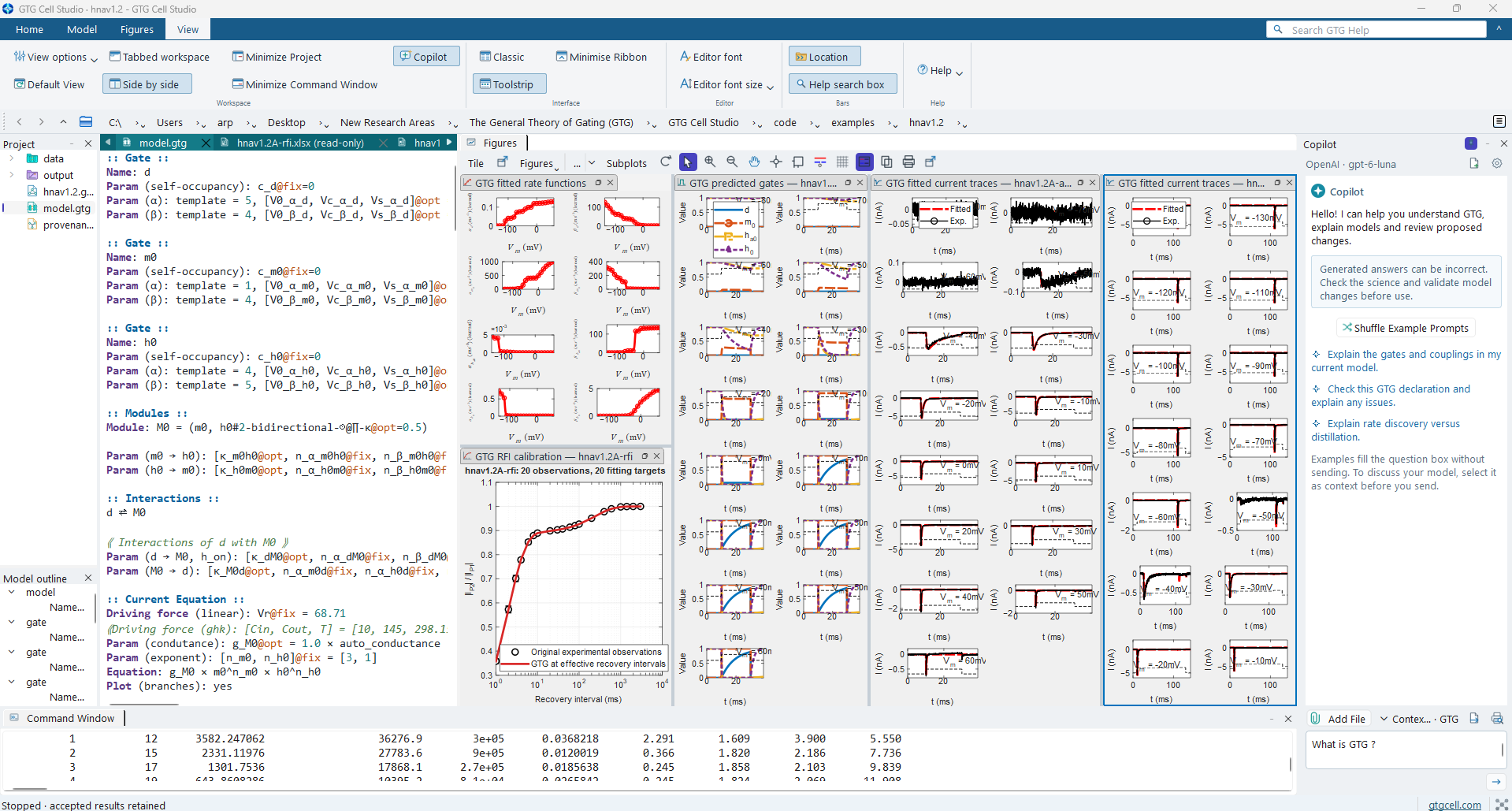
GTG Cell Studio.
I have developed a native research workspace bringing model editing, experimental-data inspection, simulation, fitting and scientific figures into one application. The current public repository distributes the compiled Windows research preview; the framework implementation and full manuals are not publicly distributed there.
An installation key is required. The project website and release repository provide the current access instructions, examples, dependencies and limitations.
The research manuscripts.
- The General Theory of Gating: a compositional theory of human ion-channel dynamicsManuscript in preparation · 2026
- GTG Cell Studio: a language and compiler framework for ion-channel modellingManuscript in preparation · 2026
Physiology beyond an individual channel.
The wider aim is to make channel models useful and reusable in computational physiology, from microglial electrophysiology to broader cellular modelling. Disease-relevant modelling, experimental design, variant interpretation and future pharmacological research are potential applications, not claims of clinical validation.
My role centres on the mathematical framework and computational development. Collaboration with Professor Mark L. Dallas at the University of Reading and Dr Moza Al-Owais at the University of Leeds connects the modelling to electrophysiological data and physiological expertise.
The published foundation.
Generalised Hodgkin–Huxley model captures human P2X and AMPA receptor currents
The Journal of Physiology 604(1), 214–246
A shared, interacting-gate framework for human P2X1–7 and AMPA GluA1 receptor currents. First and corresponding author; mathematical framework, fitting and implementation.